Table des matières
Lettering
 A1 proofreading not yet effective for this page. In the meantime, you can ask any questions on the forum.
The allocation of an account (generally a third party account) is an accounting operation which consists of assigning a “mark” in the entries making up the movement, the sum of the credit entries having to be equal to the sum of the debit entries. The goal is to associate the operations (for example associate an invoice and its payment, or a payment which settles three invoices with these three invoices), and to note which operations remain without association. The marker used is often a letter of the alphabet, hence the name lettering.
There are three lettering techniques:
- manual lettering,
- automatic lettering a priori
- automatic lettering a posteriori.
 More info: Lettrage Comptable on Wikipedia.
Automatic lettering
Automatic matching consists of automatically associating payments with invoices. This is the method practiced by Gestan, a priori or a posteriori.
A priori lettering
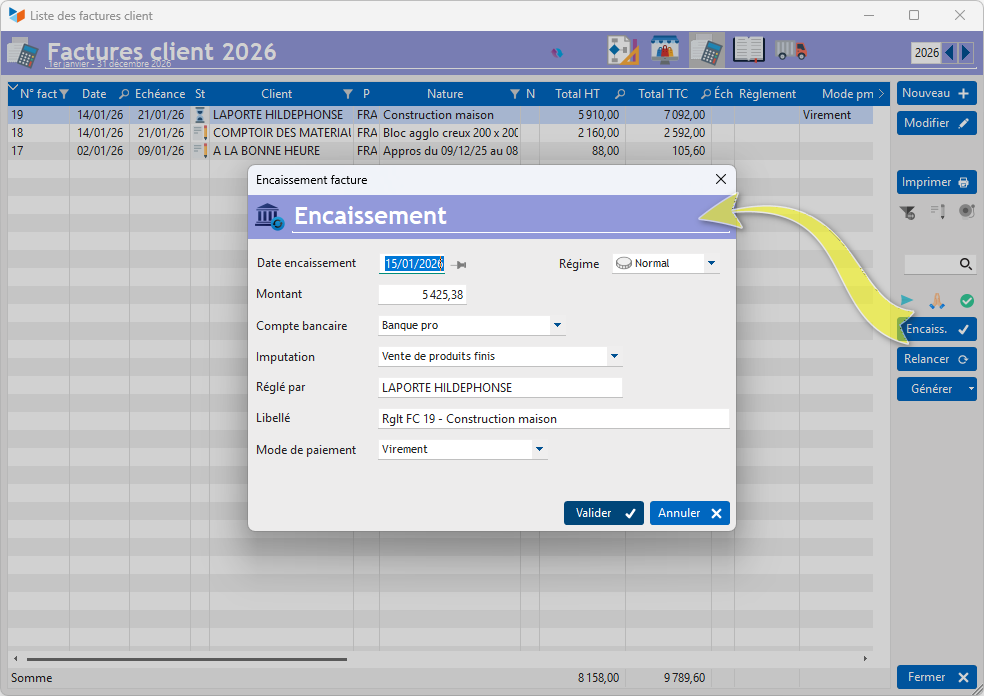
When an invoice payment is entered from the list of invoices, the collection screen above allows you to record the amount paid, to which account, on what date and by what means. The program automatically associates the entry with the invoice concerned. This is an automatic lettering a priori.
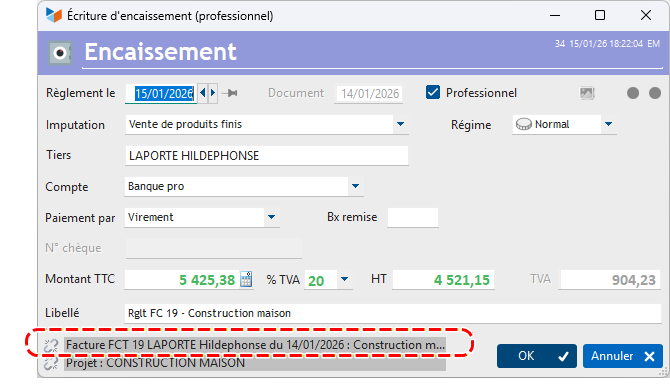
We see that on the “Collection” form which corresponds to the payment, the allocation was made automatically (towards FCT6, the customer invoice ID 6) and it is displayed on the collection form.
The principle is identical for supplier invoices.
Retrospective lettering
This link can also be made a posteriori. This is the purpose of the Link entry menu in the list of entries.
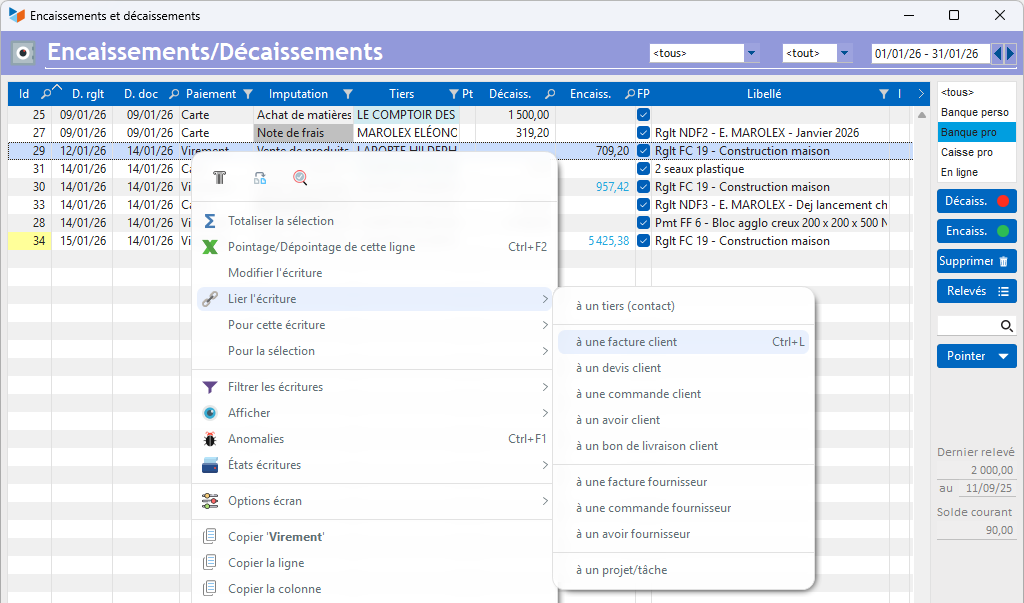
The context menu allows you to link any collection entry to any customer invoice, making an application a posteriori, or any disbursement to a supplier invoice.
It is obviously advisable to prefer the lettering a priori.
Accounting documents
The allocation information will be found in the accounting journal, the general ledger, and in the accounting export.
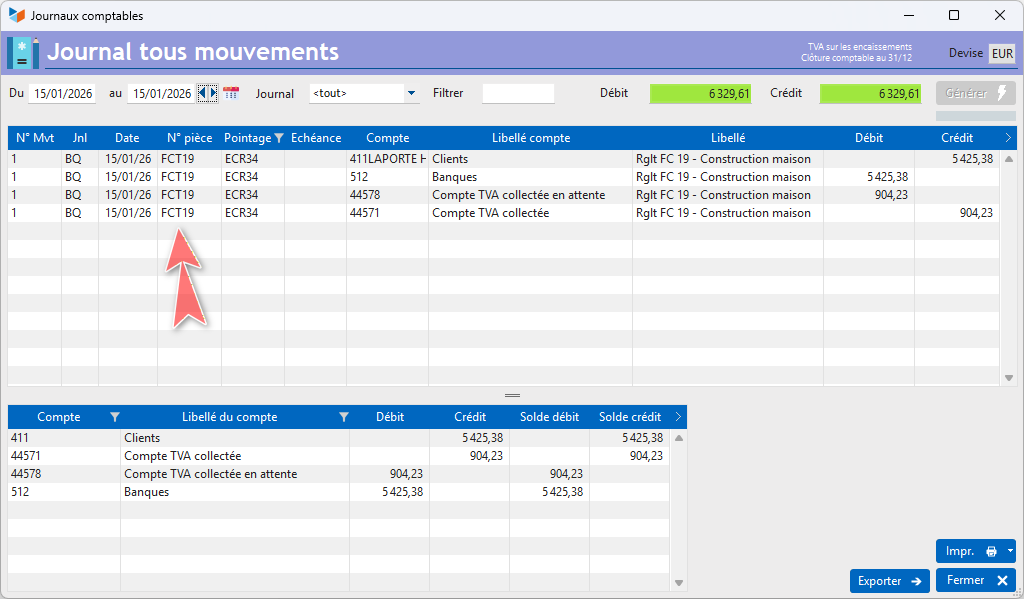
Lettered entries in the journal.
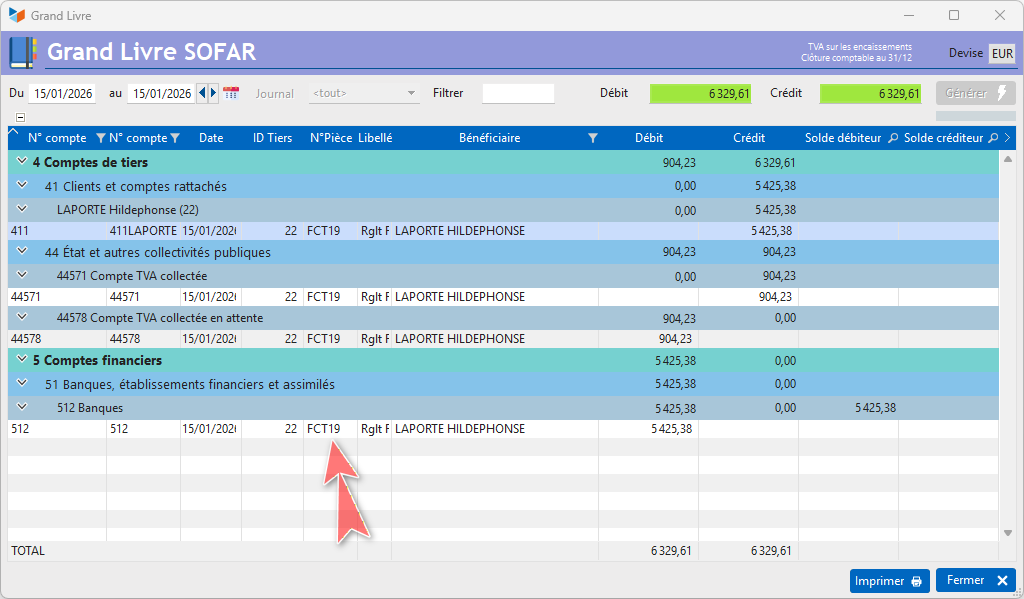
Lettered entries in the ledger.
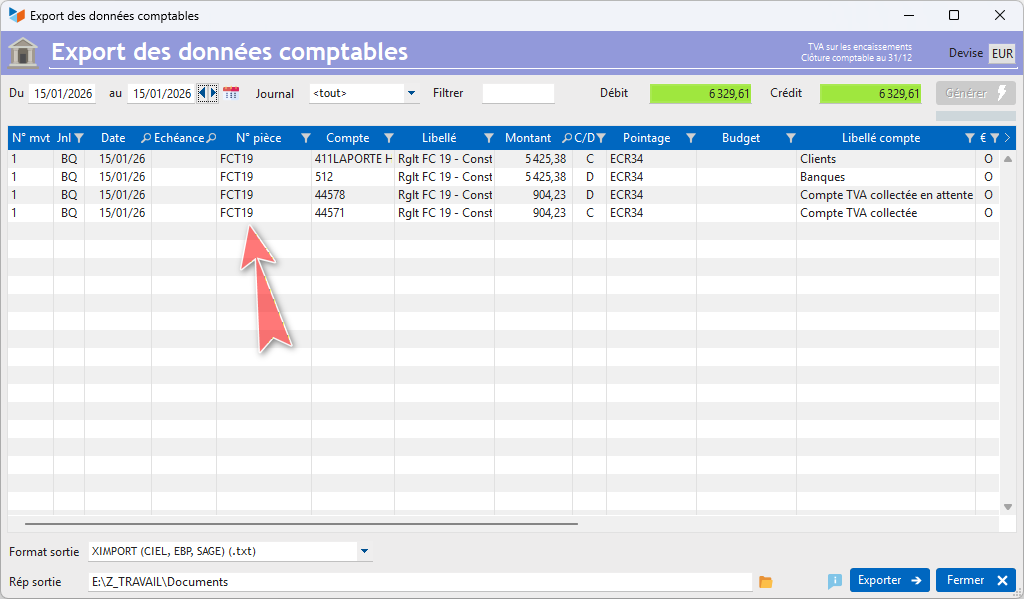
Entries applied in the accounting export.
 Other Accounting articles
Accounting document options
Accounting entries
Accounting entries
Accounting journals
Accounting links
Accounting settings
Accounting with Gestan: the main principles
Bad debts
Balance
Bank account statements
Bank or cash accounts
Billing by tax rate
Certification of cash register software - NF525 standard
Chart of accounts
Delivery of checks
Documents without imputation
Export CFONB
Fixed assets
General Ledger
Income and expenses
Income statement
Lettering
Log codes
Mass links: entries
Micro-Enterprise / Self-Enterprise
Payments
Pointing of supporting documents for VAT
Review entries
SEPA Export
Third party balance
VAT calculation
VAT orders
XIMPORT export of accounting data