Table des matières
Professional career
 A1 proofreading not yet effective for this page. In the meantime, you can ask any questions on the forum.

Each stage of the professional journey of the company's staff can be recorded in Gestan:
- diplomas,
- certificates,
- qualifications,
- hierarchical levels,
- annual ratings,
- annual interviews, VAE, medical examinations, remuneration, sanctions, etc.
If any company stakeholder has consultation access to the professional career stages that concern them, only users with HR privileges have access to all career paths.
Validation workflow
When there is a double signature validation (author + collaborator concerned), the workflow is as follows:
- The author writes the stage of the journey. By default, the file will be in “Private” mode, so that it is only visible to its author.
- When the author has finished, he/she changes the form to Validated status.
- If it is validated by the author, the collaborator will also be able to validate the form. From then on, it can no longer be modified by the author.
- If the collaborator devalidates it, a mention is added to the file, and the author will be able to modify it again, then revalidate it, and it can also be validated again by the collaborator.
List of career paths (User view)
//Access: Company → Professional career //
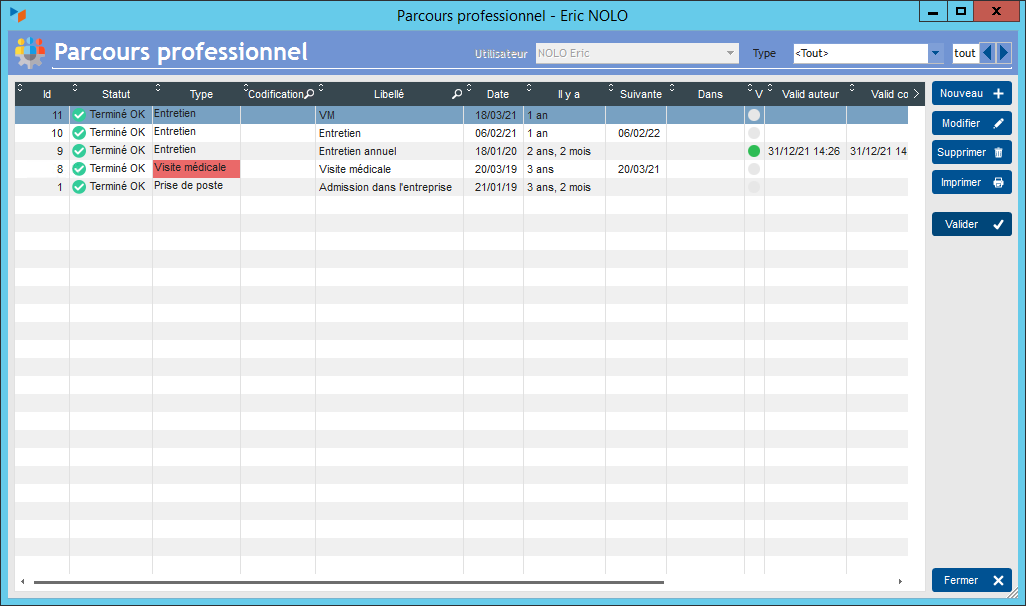
This screen presents, for the connected user, the list of stages of their professional journey.
It is possible for any user to create a new stage for their own career.
A step can only be viewed by the user it concerns, and by the user who created it. A step can only be deleted by the user who created it.
The Validate button allows you to validate a step. This is particularly useful for annual maintenance reports.
Professional career sheet

This screen presents information regarding the career path stage.
The context menu of Type allows you to add types of stages (training, qualification, changes of services, salary conditions, etc.)
The Codification field allows you to add a coding that is specific to you, such as CACES for the “training” type.
Course management screens - HR view
For HR managers (users with HR privileges), two screens are available to manage staff career paths.
Staff list and background
**Prerequisites: **The user must have HR privileges.
**Access: **HR → Staff list.

This screen presents the users in the top table, the professional paths in the bottom table.
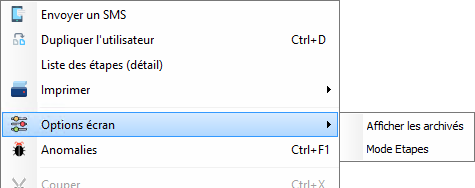
The context menu of this screen allows you to switch to a “Steps” viewing mode, which allows you to display, for a type of step, the last step of the type recorded for each user. This makes it easy to view, for example, the date of the last medical visit, or the date of the last professional interview.
 More information: Personals.
List of routes
**Prerequisites: **The user must have HR privileges.
**Access: **HR → Career paths

This screen is identical to the one accessible by users, but it allows you to display the paths of all users.
The career paths screen allows you to manage any type of event, including
- medical visits for staff,
- and recurring interviews.
Below are the provisions applicable in France.
The work medical examination
Any private or public company that employs people is concerned by the obligation to organize or join an occupational prevention and health service. Individual employers are also required to join an occupational prevention and health service.
The contact details of the occupational doctor are transmitted by the DDETS (Departmental Directorate in charge of employment, work and solidarity, formerly DIRECCTE)
The medical monitoring obligation applies to all employees on permanent contracts, fixed-term contracts, temporary contracts and apprenticeship contracts. Trainees (in the context of school and university teaching) are not concerned.
The occupational physician carries out (mainly preventive) occupational health actions to preserve the health of workers throughout their professional career. It monitors the state of health of workers according to their age, risks concerning their safety, their health and arduousness at work. He does not provide care. It does not issue prescriptions or sick leave.
As part of his missions, the doctor draws up a company file, which notably includes the professional risks of the company and the number of employees exposed to them, which is transmitted to the employer. The occupational physician also prepares an annual report of his activity. This report is sent in particular to the social and economic committee (CSE) and to the employer.
The occupational physician has free access to the workplace. He carries out visits on his own initiative or at the request of the employer or the social and economic committee (CSE).
There are several types of medical examinations for employees:
- Information and prevention visit: this is the most common visit. The VIP has replaced the recruitment medical examination. It is carried out within a maximum period of 3 months from hiring (or before hiring for minors and night workers). It can be carried out by the occupational physician or by an occupational health professional. The visit is renewed within a maximum period of 5 years. The deadline is set by the occupational physician.
- Reinforced individual monitoring concerns employees exposed to certain risks (for example, asbestos, lead, hyperbaric risk, etc.). Employees exposed to particular risks for their health or safety, for those of their colleagues or third parties, benefit from enhanced individual monitoring (SIR) of their state of health. This monitoring includes a medical aptitude examination before employment leading to the issuance of an opinion of aptitude or incapacity by the occupational physician. This exam is renewable.
- Pre-resumption visits: organized by the occupational physician at the request of the employee, their attending physician or the Social Security medical advisor for a work stoppage of more than 30 days starting after March 31, 2022 and resumption work
- Mid-career medical examination: organized in the calendar year the employee turns 45, unless otherwise provided by the branch agreement.
- Visits carried out at the request of the employer, worker or occupational doctor
Recurring interviews
In France, there are two types of recurring interviews for employees:
- the assessment interview, which aims to assess the employee's professional skills
- the professional interview, which aims to support the employee in their prospects for professional development (qualifications, change of position, promotion, etc.) and identify their training needs.
The annual evaluation interview
The law does not impose it on the employer. It can, however, be imposed by the collective agreement.
The evaluation often takes the form of an annual interview between the employee and their supervisor to take stock of the work accomplished and take stock of the achievement of objectives.
The employee cannot refuse to be evaluated by his employer. The results obtained are confidential (and protected by the GDPR if applicable): only the employee concerned can have knowledge of them.
If the employer decides to set up an evaluation system, it must concern all of the company's employees.
An assessment grid can serve as a support for the interview. It includes criteria to measure the adequacy of the employee's professional skills to the requirements of the position.
The collective agreement may provide for the obligation for the employer to provide a written report to the employee. If this is the case, the employee is not required to sign it.
The employee is not authorized to be assisted by a staff representative during the interview.
If desired, the employer can offer, for example, an increase in remuneration or a promotion. One or more poor evaluations (for example, failure to achieve objectives) do not allow the employer to demote. Likewise, one or more poor evaluations are not enough, on their own, to justify dismissal. However, they may constitute one element (among others) which may justify dismissal for professional inadequacy.
https://www.service-public.fr/particuliers/vosdroits/F31854
The professional interview
The interview is devoted to prospects for professional development, particularly in terms of qualifications and employment.
It must inform the employee about the validation of acquired professional experience (VAE) and include information on the activation of the personal training account (CPF) and the possibilities of financing by the employer.
The specific content is defined by the branch or company agreement. In their absence, the employer defines the content of the interview according to the strategic orientations of the company.
//Example :
- Review of the employee's professional career before and since joining the company
- Identification of the company's needs and the employee's aspirations and skills
- Prospects for professional development//
The professional interview concerns all employees regardless of their contract or working time, in all companies and all sectors of activity. The professional interview must take place every 2 years (from entry into the company, then from the date of the previous interview).
It must be systematically offered to any employee who returns to work after a period of interruption due to one of the following cases: Maternity leave, Full-time or part-time parental leave, Adoption leave, Caregiver leave, Sabbatical leave, Secure voluntary mobility period, Sick leave of more than 6 months, Union mandate
The interview must take place during working time and is considered effective working time. It takes place on the company's premises.
Inventory every 6 years
Every 6 years, the professional interview must provide a summary inventory of the employee's professional career. This inventory makes it possible to verify that the employee has actually benefited from the professional interviews planned over the last 6 years.
A report on the inventory is written during this interview. A copy is given to the employee.
 Other Users articles